Minus Eighty and No Instructions: When a Freezer Dies With the Knowledge Inside It
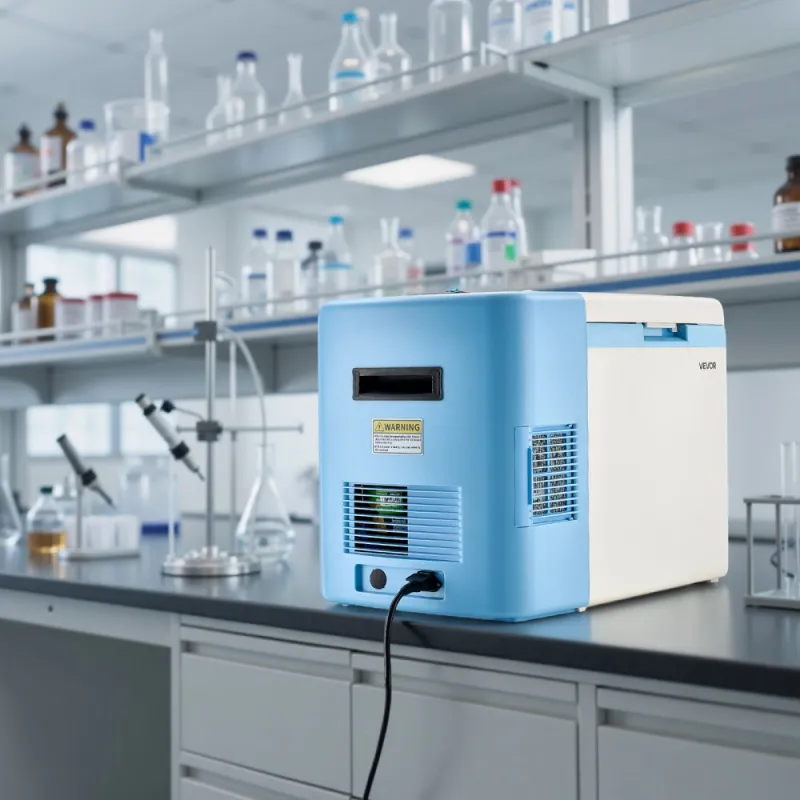
Photo: ultralow freezer laboratory samples storage, via img.vevorstatic.com
The call usually comes on a weekend. A Facilities Management technician notices the alarm, or worse, nobody notices until Monday morning, when the digital readout on a -80°C ultralow freezer has climbed past -40°C and the compressor has given up for good. Inside sit cell lines, plasma aliquots, mutant strains, and tissue blocks — some of them irreplaceable, some of them collected by researchers who retired years ago. In the weeks that follow, a second kind of failure becomes visible: nobody can say for certain what was in those boxes, or who has the authority to decide what happens next.
KSMV spoke with laboratory managers, research compliance officers, and principal investigators at institutions across the United States about freezer failures and the documentation gaps they expose. The pattern they describe is consistent: the equipment is monitored, insured, and serviced, but the intellectual inventory inside it lives — and often dies — in one person's head.
The Alarm Works. The Archive Doesn't.
Modern freezer infrastructure is, in many respects, a success story. Remote monitoring systems page staff around the clock. Backup storage agreements with neighboring departments are common. Some universities maintain centralized biorepositories with redundant compressors, liquid nitrogen backup, and dedicated emergency response protocols. When these systems work, a compressor failure is an inconvenience, not a catastrophe.
The vulnerability lies elsewhere. Ask a lab manager to produce a complete, current inventory of a faculty member's freezer and the answer is frequently a shrug, a partially updated Excel file, or a stack of handwritten box maps last revised before the COVID-19 pandemic. Samples are labeled with cryptic abbreviations understood by a single graduate student who graduated two years ago. A drawer marked "D. melanogaster — see Greg" may reference a postdoc who returned to Seoul in 2019.
This is not carelessness. It is the predictable result of how academic laboratories are structured: materials accumulate over decades of grant cycles, personnel turn over every few years, and no requirement anywhere in the typical grant or institutional policy compels anyone to maintain a living inventory. The freezer becomes an archive without a catalog.
What a Catastrophic Loss Actually Costs
The financial arithmetic is sobering. Replacing antibodies, reagents, and commercially available cell lines is expensive but straightforward. The losses that sting are the ones with no commercial substitute: patient-derived xenografts from a closed clinical trial, serial plasma samples from a longitudinal cohort study that took fifteen years to recruit, genetically engineered mouse lines whose founders are long gone.
When such collections are lost, the damage radiates outward. Collaborators at other institutions lose access to shared materials. Ongoing studies may be unable to complete planned analyses. In cases involving human subjects, the loss can foreclose the possibility of ever recreating the cohort — participants cannot be re-consented for a study that no longer exists. The true cost is measured not in replacement dollars but in knowledge that simply cannot be regenerated.
The Retirement Problem
Several of the most serious incidents described to KSMV did not involve equipment failure at all. They involved departures: a professor emeritus who moved across the country and left a freezer full of "probably junk," a lab that closed after a grant lapsed, a PI who passed away unexpectedly. In each case, the successor inherited boxes with no provenance — no records of what the samples were, whether they were correctly characterized, or whether they were even safe to thaw.
Universities have policies for retiring computers, disposing of chemicals, and transferring radiological materials. Few have comparable requirements for biological collections. A departing faculty member may sign off on hazardous waste and intellectual property, yet leave behind two hundred boxes of unlabeled vials that no one is authorized to discard, because discarding them might destroy something valuable — and no one knows.
Toward a Freezer Will
The proposed remedy has begun to circulate under an informal name: the freezer will. The concept is a short, standardized document — reviewed annually, updated at every personnel change — that answers a handful of basic questions. What is in the freezer? Which samples are irreplaceable, and which can be discarded? Who holds succession authority if the PI leaves? Is there a backup location for priority materials? Has the inventory been verified within the last twelve months?
Advocates within the sample-management community suggest such documents could be attached to existing institutional touchpoints: grant renewals, IBC reviews, sabbatical notifications, retirement paperwork. Others argue professional societies have a role to play in establishing norms, much as they have done for data management plans and mentoring agreements.
None of this requires new technology. It requires the recognition that a biological collection is not merely equipment — it is institutional memory held at minus eighty degrees, and like all memory, it survives only if someone takes responsibility for writing it down before the compressor fails.